electrical-maintenance-singapore
Electrical safety is one of the most overlooked aspects of home ownership in Singapore. Most of us switch on the air-conditioner, charge our phones an
- AIM Global Engineering Team
- 6 min read
Electrical safety is one of the most overlooked aspects of home ownership in Singapore. Most of us switch on the air-conditioner, charge our phones and run the water heater without ever thinking about the distribution board tucked behind the front door. Yet a single unprotected circuit is enough to turn an ordinary household fault into a serious incident.
This guide explains what every HDB and condominium owner should know about the RCCB, DB box and MCB, the regulations that came into force in 2025, and the practical steps you can take to keep your home safe.
What Is a DB Box and Why Does It Matter?
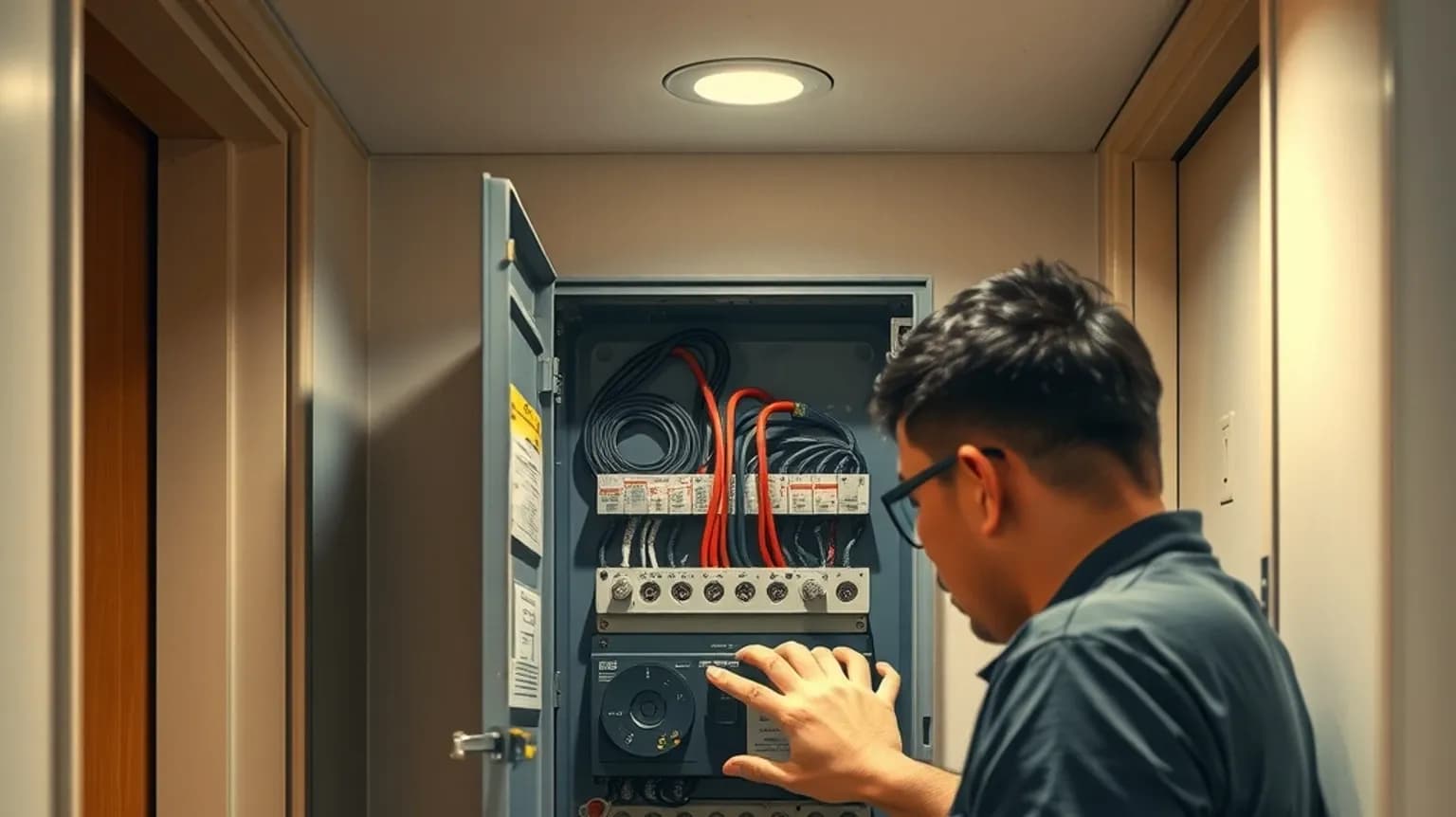
The distribution board — commonly called the DB box — is the control centre of your home's electrical system. It takes the incoming supply and splits it into individual circuits for lighting, power points, air-conditioning, the water heater and other appliances. Inside the DB box sit the MCBs (Miniature Circuit Breakers) and the RCCB (Residual Current Circuit Breaker).
An MCB protects a single circuit from overload and short circuit. If you plug too many appliances into one extension and the breaker trips, that is an MCB doing its job. An RCCB works differently: it detects earth leakage — current escaping to earth, often through a person — and cuts the supply within milliseconds. This is the device that protects human life, not just wiring.
In a typical HDB flat, the DB box is mounted on the wall near the main entrance at roughly eye height, and contains one or two RCCBs covering all circuits, with individual MCBs for each circuit.0 If your flat still runs the original board from the 1970s or 1980s, there is a real chance it has no RCCB at all.
The 2025 RCCB Regulation: What Changed
Under the Electricity Act and EMA regulations, all residential premises in Singapore must have an RCCB or ELCB rated at 30 mA or lower. For pre-1985 residential premises — including older HDB flats, condominiums and landed homes — retrofitting was required by 1 July 2025, with non-compliance attracting fines of up to S$5,000.0
This is not a technicality. A DB without an RCCB exposes occupants to direct electrocution and fire hazards, and many older flats have been living with this hidden risk for decades.0 If you are unsure whether your home complies, the simplest check is to open the DB cover and look for a switch with a test button — usually labelled 'Test' or 'T'. Do not remove the cover or touch internal parts; if you cannot identify it, call a Licensed Electrical Worker.
Why Your MCB Keeps Tripping
A breaker that trips repeatedly is telling you something. The most common causes are:
- Overloaded circuit — too many high-load appliances sharing one MCB.
- Faulty appliance — a failing motor, heater or power supply drawing excessive current.
- Short circuit — damaged cable insulation or a loose connection touching metal.
- Weak or ageing breaker — MCBs do wear out over decades of service.
- Moisture ingress — especially in kitchens, bathrooms and service yards.
Resetting the breaker once is reasonable. Resetting it repeatedly without finding the cause is not — and fitting a larger breaker to stop the tripping is dangerous, because the cable may no longer be protected. Any work on the distribution board, including replacing an MCB, RCCB or ELCB, must be performed by a Licensed Electrical Worker (LEW) under the Electricity Act.0
Warning Signs You Should Not Ignore
Call a licensed electrician immediately if you notice any of the following:
- A burning smell near the DB box, a socket or a switch.
- Scorch marks or discolouration on breaker casings or socket plates.
- Buzzing or crackling sounds from the DB box.
- Sockets or switches that feel warm to the touch.
- Lights that flicker or dim whenever an appliance starts.
- An RCCB that will not reset, or that trips immediately after resetting.
These are not cosmetic issues. Heat damage at a terminal is a precursor to fire, and an RCCB that will not hold is either detecting a genuine earth fault or has failed internally. Both require professional testing.
How Often Should You Inspect Your Electrical System?
For most homes, a visual check of the DB box and a test of the RCCB trip button every six months is sensible. Press the test button — the RCCB should trip immediately. If it does not, the device is not protecting you and needs replacement.
A fuller inspection by a licensed electrician is worthwhile every few years, and immediately after any renovation, addition of a high-load appliance, or purchase of a resale flat. Renovation works frequently leave behind unauthorised additions and overloaded circuits that are invisible until something fails.
What a Professional Electrical Safety Check Covers
A proper inspection goes beyond looking at the DB box. It should include verification of breaker ratings against cable capacity, terminal tightness, RCCB trip testing, insulation resistance testing, earthing continuity and a check for unauthorised wiring. At AIM Global Engineering PTE LTD, our electrical team carries out these checks with proper instruments and provides a written record of findings.
If you are buying a resale flat or renting out a unit, an electrical inspection before handover is one of the cheapest forms of risk management available. It costs far less than repairing fire or water damage later, and it gives you documented evidence of the installation's condition.
Frequently Asked Questions
Does my HDB flat definitely have an RCCB?
Not necessarily. Flats built before 1985 often did not come with one, and the 2025 regulation required retrofitting. Check for a test button on the DB cover, or ask a licensed electrician to confirm.
Can I replace my own MCB?
No. Under the Electricity Act, any work on the distribution board must be carried out by a Licensed Electrical Worker. Replacing a breaker yourself risks shock, fire and invalidating your insurance.
How much does an RCCB installation cost?
Cost depends on the DB box condition and whether spare ways are available. As a rough guide, RCCB replacement is typically in the low hundreds of dollars, while a full DB upgrade costs more. A site inspection gives an accurate figure.
Why does my RCCB trip only at night?
This often points to an appliance used mainly at night — a water heater, air-conditioner or outdoor light — or to condensation affecting a circuit as temperatures drop. It requires circuit-by-circuit testing to isolate.
If you would like your home's electrical safety checked, contact AIM Global Engineering PTE LTD at +65 9081 8494 or email aimglobal.sg@gmail.com. We are BCA and ACRA registered (UEN 202211612M) and serve HDB flats, condominiums, offices and shops across Singapore.
Featured Services